AI Cover&Music Maker · Bach AI
- 4.1
- Rating
- 100.00K
- Installs
- Free
- Price
 Analysis by App-foxy
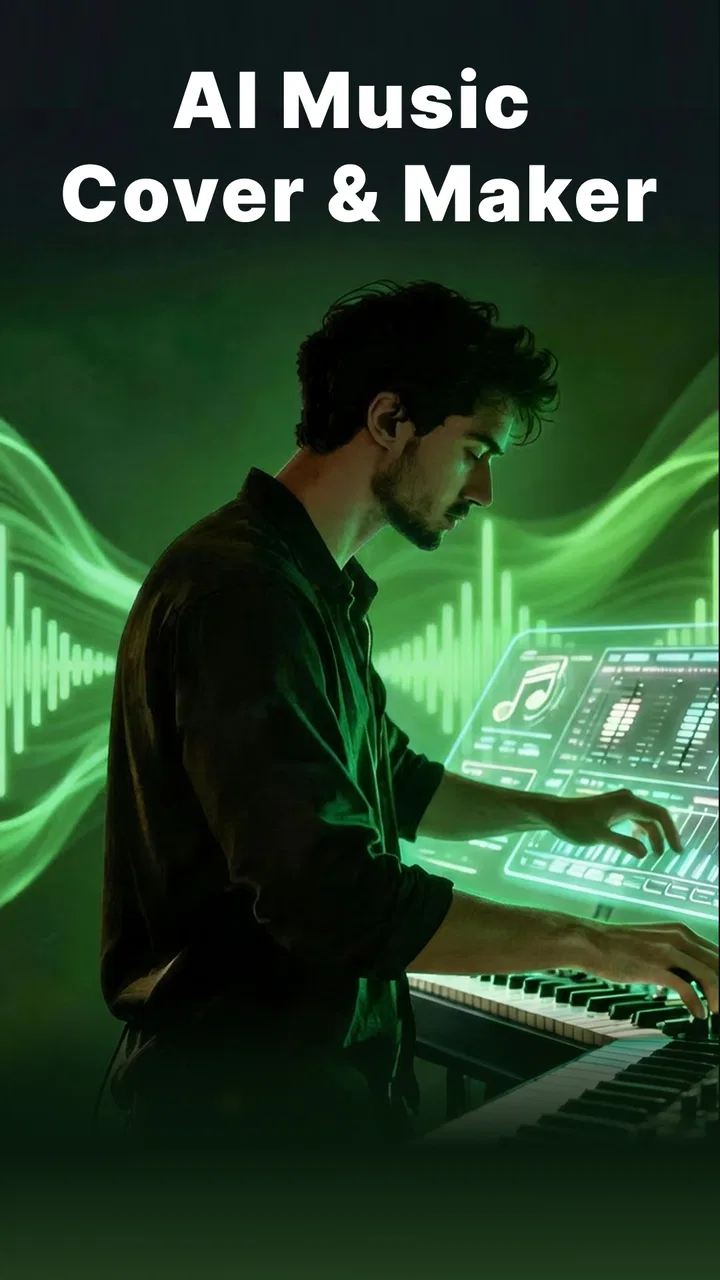
I approached AI Cover&Music Maker · Bach AI as a music tool for quick experiments rather than as a replacement for a full recording studio. It belongs to the Music & Audio category, comes from AI Chat Studio, and focuses on two appealing ideas: creating an AI cover in a voice you enjoy and turning a musical idea into a finished-sounding piece. That combination makes it interesting for casual creators, singers, curious listeners, and anyone who wants to test a concept without opening a complicated desktop program.
The app is free to start, with in-app purchases ranging from $3.99 to $199.99 per item. That pricing detail matters because AI audio tools can become tempting to use repeatedly, especially when a first experiment produces something surprisingly entertaining. I would therefore treat the free access as a chance to understand the workflow, not as a promise that every ambitious project will remain cost-free.
My overall impression is positive but practical: the appeal is immediate, while the quality of a result depends heavily on the idea you provide, the source material you choose, and your patience during generation. The experience is also closely tied to connectivity. When the app needs to process an input remotely, a weak or interrupted connection can make the creative process feel less like playing an instrument and more like waiting for a service to respond.
You May Also Like

 Pandora - Music & Podcasts
Pandora’s Music Is Easy to Start, but Harder to Recover
Pandora’s strength is its low-effort path from a seed to a station. Its weak spot is how much confidence it asks you to place in connection, setup, and quiet recovery.

 8 Ball Pool
 Is Built on Rivalries, Rematches, and Routine
A close look at the rivalries, rematches, shared routines, and unanswered safety questions that turn a quick pool match into a persistent mobile community.

 Samsung Music
’s Quiet Strength Is Playing What You Already Own
Its reach comes less from spectacle than from dependable access to a personal library. That simplicity is both the app’s strongest retention engine and its ceiling.

 AccuWeather: Weather Radar
AccuWeather Review: A Quick, Clear Forecast for Everyday Decisions
For everyday plans, the best forecast is the one you can understand quickly. AccuWeather makes rain timing, radar, and local conditions easy to act on, with a few trade-offs.

 Hill Climb Racing
Why Hill Climb Racing Still Turns Crashes Into One More Run
A tiny car, a bumpy hill and one more upgrade: Hill Climb Racing keeps resurfacing because its simple chaos makes every near-miss feel personal.

 AliExpress - Shopping App
AliExpress Makes Global Shopping Feel Personal, but Shoppers Bear the Risk
AliExpress turns a global marketplace into a pocket-sized discovery engine. Its reach is useful, its shopping loop compelling, and its trade-offs easy to miss.
More From Our News Desk
View All News


What the app is really useful for
The most enjoyable way to use this app is to start with a small creative question. Instead of asking it to carry an entire music project, I would use it to explore a melody, imagine a different vocal character, or hear how a familiar song might feel in another style. That narrower approach produces a better experience because it keeps expectations realistic and makes each attempt easier to judge.
The cover function is the obvious starting point. A user can bring a song idea into the process and see how an AI voice changes its personality. This is useful for mood boards, private demos, playful sharing with friends, and early songwriting decisions. It is not the same as hiring a singer or recording a human performance. The attraction is speed and curiosity: you can investigate a vocal direction before spending time on a full arrangement.
The music-making side is more open-ended. Someone who has a lyric fragment, a rough theme, or only a mood in mind may find it easier to begin here than in a traditional digital audio workstation. A conventional studio app gives you precise control over tracks, effects, timing, and editing, but that control can also become a barrier. Bach AI is more approachable when the goal is to move from an idea to an audible sketch quickly.
I would not describe it as a detailed production environment. If you need multitrack editing, exact vocal comping, advanced mixing, or careful mastering, a dedicated music workstation remains the stronger choice. The advantage here is the opposite: less setup, fewer technical decisions, and a faster route to hearing a possibility.
Connectivity changes the creative rhythm
The network is not just a background detail in an AI music app. It can shape the entire rhythm of a session. A strong connection lets you submit an idea, wait through processing, and continue judging the result. A poor connection introduces uncertainty at the exact moment when you want quick feedback. The delay can make it harder to remember why a particular prompt or source was chosen, especially when you are testing several variations.
I found it helpful to prepare the creative material before starting a generation request. Decide what you want to test, keep the wording of your idea concise, and avoid changing several variables at once. If the result is disappointing, you then know whether the problem was the concept, the vocal direction, or the musical mood rather than simply having thrown everything into one request.
This is one of the app’s less obvious trade-offs. AI promises spontaneity, but network-based processing rewards organization. A user who treats every attempt as a random button press may spend more time waiting and less time learning. A user who keeps a simple sequence of experiments can compare results more intelligently and recognize which choices actually improve the output.
For that reason, I would use it on a reliable home connection for serious experimentation and reserve mobile data for short, low-stakes tests. A quick idea while commuting can be fun, but it is frustrating if a generation stalls just when you are about to hear the part you were most curious about.
Why mobile use works, and where it becomes awkward
The app makes the most sense on a phone when inspiration arrives away from a desk. Imagine humming a melody after hearing a rhythm in a café, writing down a chorus idea during a break, or wanting to demonstrate a vocal concept to a friend without opening a laptop. In those situations, a focused AI music app can remove enough friction to make the idea feel worth pursuing.
Short sessions are particularly suitable. I would open it with one clear objective, create a result, listen carefully, and decide whether the idea deserves more work elsewhere. That workflow prevents the phone from becoming a place where unfinished experiments accumulate without any useful conclusions.
There is also a social use case. A person who does not consider themselves a musician can use the app to turn an inside joke, birthday message, or playful lyric into something audible. The result does not need to be professionally polished to be valuable. In this context, the surprise and transformation are part of the entertainment.
Still, phone-based creation has limits. Small screens are not ideal for comparing many versions, inspecting details, or making precise corrections. If your goal is a carefully edited release, I would move the project to a more comprehensive audio environment as soon as the central idea is proven. Bach AI is better at opening a door than furnishing the whole room.
Battery and data habits also deserve attention. Repeated AI generation can be more demanding than simply listening to a downloaded song, and mobile data can disappear faster when you repeatedly submit audio-related requests. I would avoid running a long chain of experiments on a limited plan. A sensible approach is to draft ideas in a notes app first, then use Bach AI only when you have a clear test ready.
Handling interruptions without losing the point
Any app that depends on communication between your phone and a processing service can feel fragile when the connection changes. A request may take longer than expected, a result may not appear immediately, or you may need to repeat an action after moving between Wi-Fi and cellular data. I would not interpret every interruption as a problem with the music itself. First check the connection, then confirm whether the request actually completed before submitting it again.
That last step is important because impatiently tapping the same action can create confusion. You may end up with multiple attempts, uncertain charges, or several similar outputs when you only intended one. I recommend waiting through a reasonable processing period, checking the visible state of the app, and then restarting carefully rather than repeatedly pressing the generation control.
A useful recovery habit is to keep your original idea outside the app. Save the lyric, prompt, or description in a note before sending it. If the session is interrupted, you can reconstruct the request instead of trying to remember the exact wording. This also makes comparisons more meaningful because you can change one element at a time.
When a result fails creatively rather than technically, do not immediately assume that a more elaborate instruction will fix it. AI music tools often respond better to a clear central direction than to a paragraph packed with conflicting demands. I would simplify the idea, keep the intended mood obvious, and test again. That is a practical way to separate a bad request from a temporary connection issue.
Recovery is less stressful when you treat each generation as an experiment rather than as a guaranteed take. The app’s value is in helping you discover possibilities. If you need an exact performance on the first attempt, this is probably not the right tool for that job.
Using it carefully on a limited data plan
Because the app works with AI-generated music and covers, I would approach data use deliberately. The safest everyday routine is to connect to trusted Wi-Fi before exploring several variations, especially if you are working with audio rather than a short text idea. I would also avoid launching repeated tests simply because each result is entertaining. Decide what you are comparing before starting the next attempt.
There is a creative benefit to this restraint. Limiting yourself to a few purposeful trials forces you to listen more closely. Instead of chasing an endless stream of outputs, you can ask whether the vocal character fits the song, whether the mood matches the lyric, and whether the concept is strong enough to develop. That kind of listening is more valuable than generating dozens of loosely related versions.
Cost awareness belongs in the same conversation. The app itself is free, but optional purchases can range from $3.99 to $199.99 per item. I would check the purchase screen carefully and decide in advance what a single experiment is worth to me. A casual user may be satisfied with occasional use, while a creator planning many iterations should think about the total cost before committing to a large workflow.
This is also where the app differs from a traditional audio editor. A standard editor may require more effort at the beginning but gives you a predictable workspace once installed. An AI service feels easier at first, yet repeated generation can introduce both network dependence and spending decisions. The convenience is real, but it is not automatically the cheaper long-term option.
Privacy and rights should be considered in practical terms, too. I would avoid uploading material that belongs to someone else unless I had permission to use it, and I would be cautious with private recordings or unreleased songs. The ability to transform audio does not remove the responsibilities attached to the original voice, composition, or recording. For public sharing, I would be especially careful about whether the source material and the resulting cover are appropriate to distribute.
Who will enjoy Bach AI most
The best audience is someone who values quick creative feedback more than detailed control. Beginners can use it to make an idea tangible without learning a full production system first. Songwriters can use it as a sketching partner when they want to hear a vocal direction. Casual users may simply enjoy the novelty of imagining a song through a different voice or turning a small concept into a musical experiment.
It can also help people who are stuck at the blank-page stage. Hearing even an imperfect generated version can reveal what is missing from a lyric or melody. Perhaps the chorus needs a stronger emotional contrast, or the chosen mood does not suit the words. In that sense, the app is useful not only when it produces something good, but also when it exposes a weak idea quickly.
I would recommend skipping it if you want exact control over every note, a dependable professional vocal performance, or a complete production pipeline on mobile. A singer, producer, or experienced composer may find the lack of fine editing more limiting than liberating. Likewise, anyone uncomfortable with network-dependent creative tools should prefer software that keeps the main work inside a local, predictable project environment.
The app is also not ideal for someone who wants unlimited experimentation without thinking about purchases. The free entry point is inviting, but the listed purchase range reaches as high as $199.99 for an item. That does not make the app poor value by itself; it simply means the user should understand the spending boundary before turning a casual test into a habit.
How it compares with familiar alternatives
Compared with a normal music player, Bach AI is far more interactive but less predictable. A player gives you finished tracks instantly and usually handles playback smoothly once the content is available. This app asks you to participate in the creation process, which is exciting when you want something new but unnecessary when you only want to listen.
Compared with a voice recorder, it offers a much more imaginative destination. A recorder preserves your own performance, including its natural imperfections, while an AI cover tool explores an artificial interpretation. I would choose the recorder for capturing a melody that must retain your exact voice and the AI app for testing how that melody might feel through another vocal identity.
Against a full digital audio workstation, the comparison is about depth versus speed. A workstation wins for editing, arrangement, mixing, and repeatable control. Bach AI wins when the main obstacle is getting started. My preferred workflow would be to use the app for discovery, then rebuild or refine the strongest idea in a more precise tool if the project becomes serious.
It also differs from conventional karaoke. Karaoke gives you a known backing track and asks you to perform over it. An AI cover experience is more about transforming or imagining the vocal presentation. That makes it better for concept development and playful reinterpretation, but not necessarily better for practicing a faithful live performance.
Details worth knowing before installing
AI Cover&Music Maker · Bach AI is available as a free app for users aged Everyone, and it requires Android version 7.0 or later. The current version is 1.1.4, which is useful to check against your device before beginning. Its release date was May 30, 2025, so I would keep expectations grounded: a relatively recent tool may still feel like it is finding its shape as people discover how best to use it.
The app has an average rating of 4.1 from around 754 ratings and has passed 100K installs. Those figures suggest that it has attracted a meaningful early audience, while also leaving room for individual experiences to vary. I would read the rating as a reason to try it, not as a guarantee that every voice, song idea, or connection will produce the same quality.
One practical tip is to listen with a specific question in mind. Do not judge only whether the output sounds impressive at first. Ask whether the voice suits the emotional meaning, whether the arrangement supports the lyric, and whether you would actually use the result as a starting point. This turns a novelty app into a more useful songwriting aid.
Another is to keep your best ideas separate from your disposable tests. Mark the concepts that deserve further work, and do not spend equally on every experiment. The strongest benefit comes from identifying a promising direction early, not from generating the largest possible collection of versions.
My connectivity verdict
Connectivity is both the app’s enabler and its main source of friction. It allows a lightweight mobile experience to reach AI-based music creation without requiring a complex local studio, but it also means that the smoothness of a session depends on circumstances outside the creative idea itself. A stable connection makes the process feel inviting; an unreliable one can make even a good concept feel unnecessarily difficult.
I would use Bach AI for focused bursts: prepare the idea, connect reliably, run a small number of meaningful tests, and save the promising direction for more detailed work elsewhere. I would not build a time-sensitive professional workflow around it or assume that mobile data is an unlimited playground.
After trying it from that perspective, I see the app as a friendly creative launchpad. It is strongest when you want to hear a possibility quickly, especially a vocal or musical possibility that would be difficult to produce alone. Its limitations become clearer when you demand precision, continuity, or unlimited generation. For curious creators who can accept those trade-offs, it is worth exploring; for exacting producers, it is better treated as an idea generator than as the final studio.
FAQs for AI Cover&Music Maker · Bach AI
01What is AI Cover&Music Maker · Bach AI?
AI Cover&Music Maker · Bach AI is an artificial-intelligence music creation app designed to help users generate song covers, experiment with vocal styles, and produce original musical ideas. Depending on the available tools and your selected plan, you may be able to upload or choose audio, apply an AI-generated voice or style, and preview the result before saving or sharing it.
02Do I need musical or technical experience to use Bach AI?
No advanced musical knowledge is generally required. The app is aimed at beginners as well as more experienced creators, with guided controls and automated processing doing much of the difficult work. You may still need patience when selecting a suitable song, voice, or prompt, because the final quality depends on the source audio, your instructions, and the processing options available in the current version.
03Is AI Cover&Music Maker · Bach AI free to download and use?
The application may be available to download at no initial cost, but some features can be restricted by credits, advertisements, subscriptions, or in-app purchases. Before creating multiple covers or exporting high-quality audio, check the pricing screen carefully. Pay particular attention to trial periods, automatic renewal terms, credit limits, and whether removing watermarks or unlocking premium voices requires payment.
04Can I use and share the songs created with Bach AI?
You should review both the app’s terms of service and the copyright rules in your country before publishing or monetizing anything created with the application. A generated cover can still involve rights belonging to the original songwriter, recording owner, performer, or voice owner. Avoid uploading copyrighted material without permission, and do not imitate or distribute a recognizable person’s voice in a misleading or unauthorized way.
05What should I know about privacy and uploaded audio?
Because AI music tools often process recordings on remote servers, privacy is an important consideration before uploading vocals, songs, or personal files. Read the app’s privacy policy to learn how audio, prompts, account details, and generated tracks are stored and used. Avoid submitting confidential recordings or someone else’s voice without consent, and check whether files can be deleted from your account.
Pros
- Creates AI cover songs in multiple vocal styles.
- Simple interface makes music creation accessible to beginners.
- Supports experimenting with original lyrics and melodies.
- Useful for generating quick song ideas and demos.
- Offers a fun way to explore different musical genres.
Cons
- AI vocals may sometimes sound unnatural or inconsistent.
- Results can vary significantly depending on the input prompt.
- Advanced editing and mixing tools may feel limited.
- Generated songs may require credits or in-app purchases.
- Users should review licensing rules before publishing AI covers.

AI Cover&Music Maker · Bach AI
Gallery